All building works has an arena of risk about them, and none so more than the area of weathertightness. This risk is an area that needs to be managed just like all other risks with sound management strategies that lower the risk for all parties involved. Simply put – architects and councils are still being found liable in courts of law despite many problems in their eyes being beyond their control.
To address this issue and add value, Step Up Group companies have partnered with Specifiers, Homeowners and all other stakeholders to provide a full-service building weathertigtness risk management program that provides for enduring and managed buildings now and into the future.
This document aide you to understand your obligations and provide stronger evidence for the need of including proper weathertightness management in your specifications for the benefit of all.
For complete risk management for professionals, this process of weathertightess risk management needs to start right from construction – and this has been supported by many Architects. Many have said due to the assumed lack of statutory requirements for moisture management, there has been a lack of desire from owners and council to include this in their plans due to cost. However the following documentation lays out the statutory obligation for specifiers, and when read together shows an obligation for the use of moisture monitoring of structural timber to ensure structural elements meet their statutory 50 years minimum lifespan.
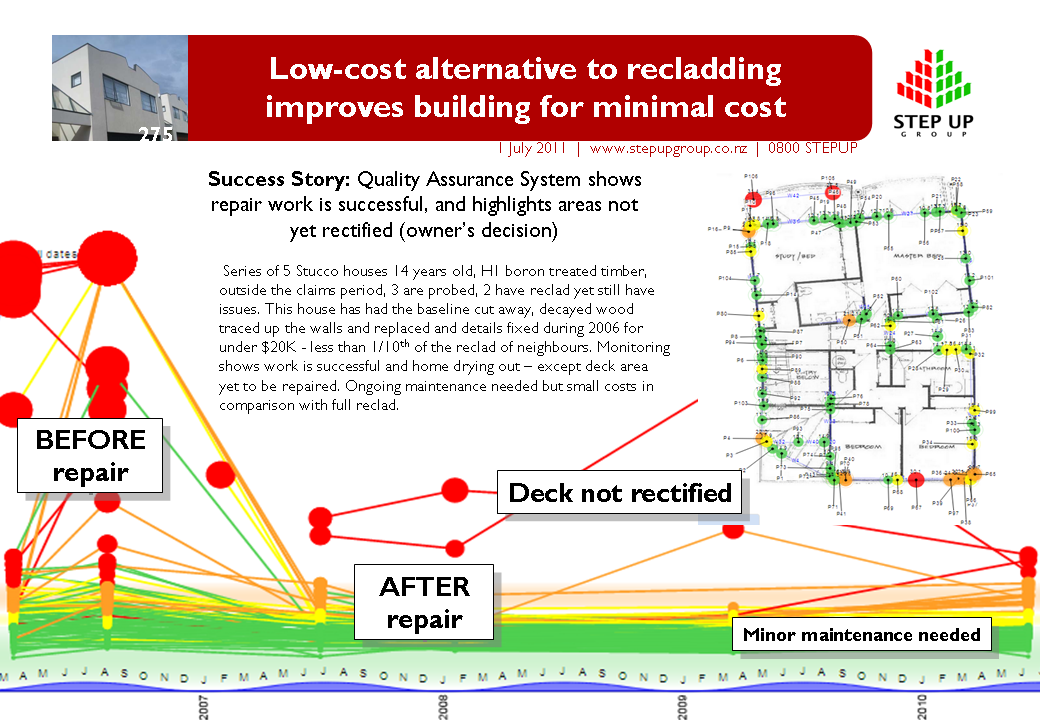
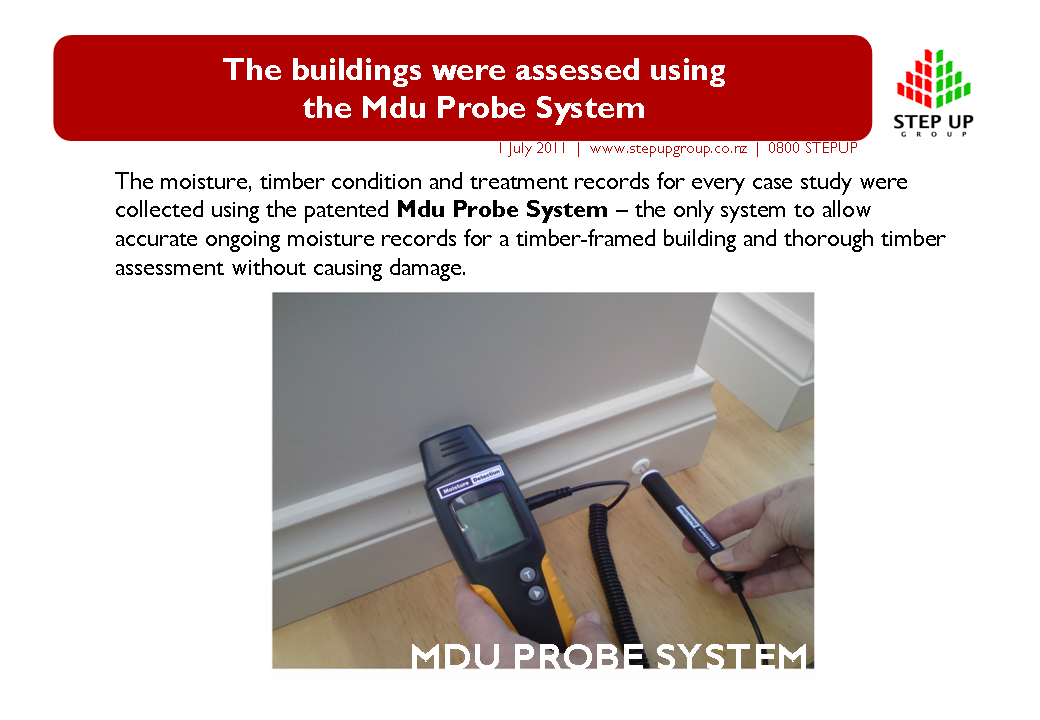
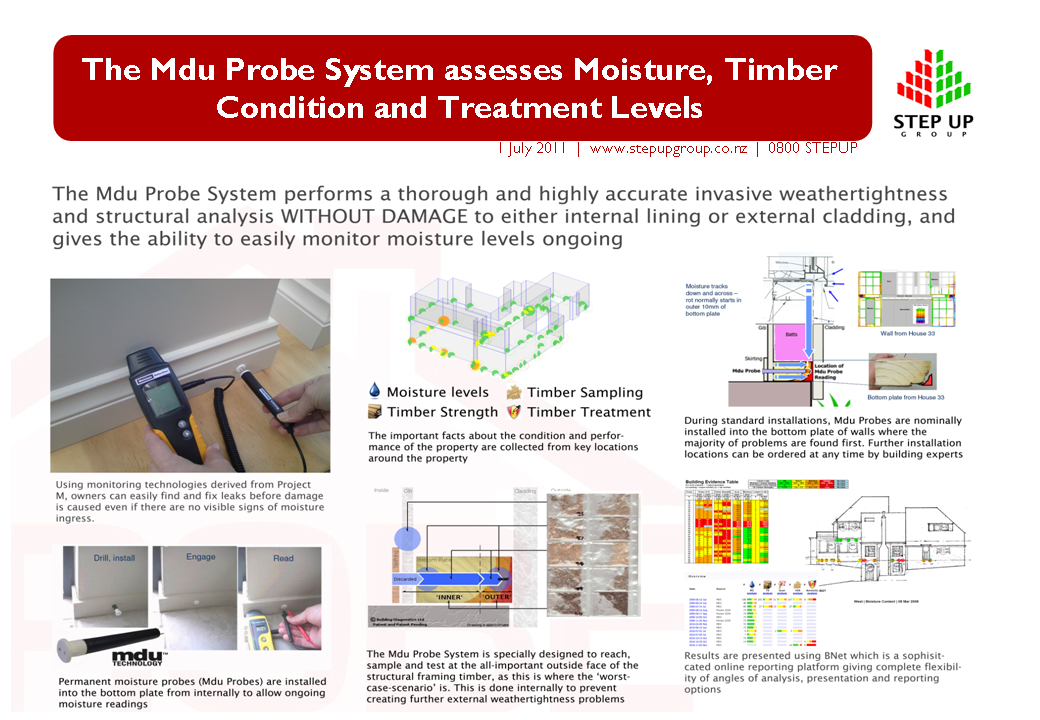
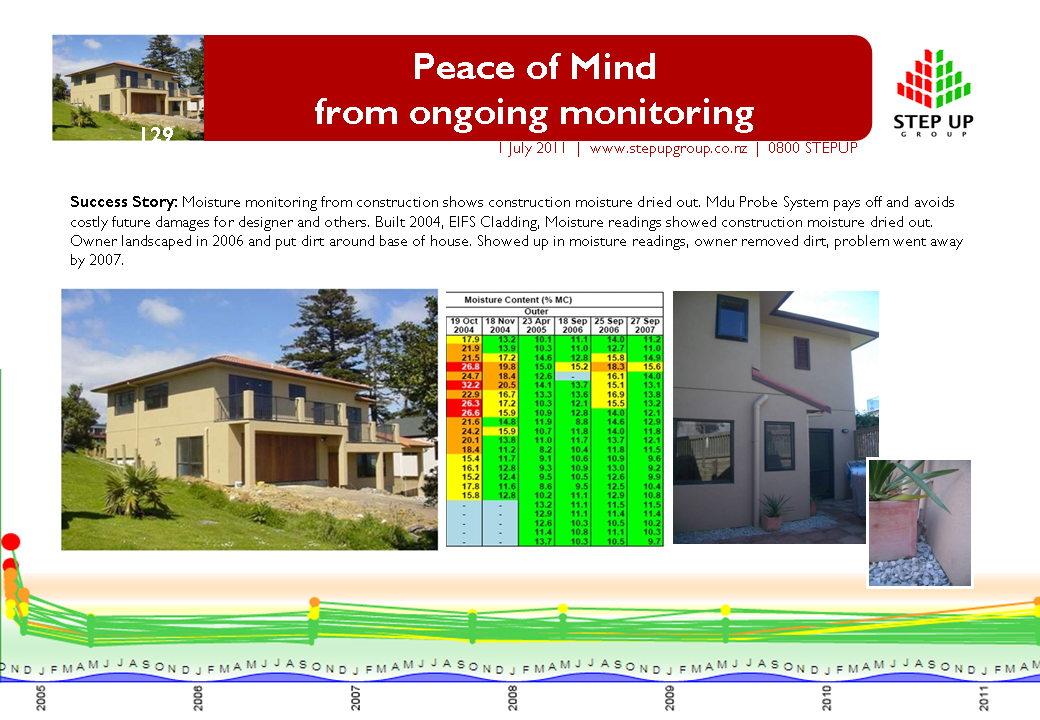
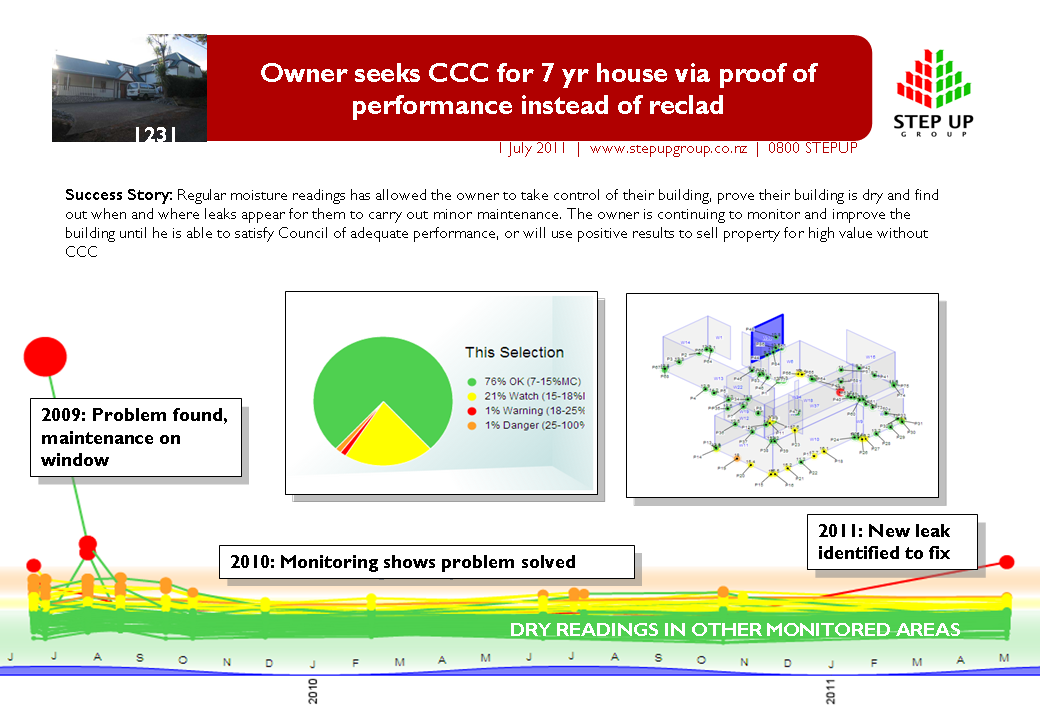
The key is monitoring the moisture levels of buildings using the Mdu Probe System. This system is now used in over 1500 homes and given protection and peace of mind to many owners and professionals, with over 1 million data collected to date. Owner-friendly services have been created to make moisture monitoring easy and rewarding for the owners. Our database shows that while things are getting better, there are still major problems that get caused – either at construction or by owners that architects are being found liable for.
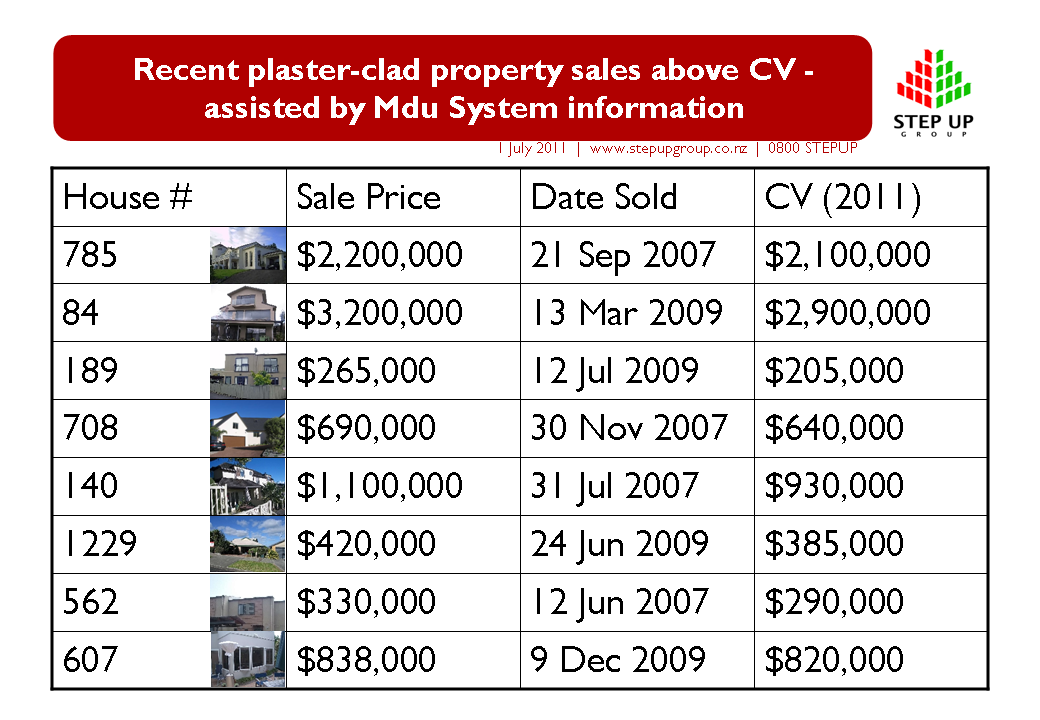
Construction Stakeholders are currently, and successfully being sued for residential building weathertightness problems inside the liability longstops
When leaks develop and timber rots within a building, if the age of the building works ‘responsible’ for these leaks and damage are within 10 years old, the combination of joint and several proceedings and current legal interpretations put high levels of responsibility squarely on the shoulders of all stakeholders involved. It is known that there have been many building failures recently in which the professionals involved have been found liable in many cases. The introduction of professional licensing will also make this liability more difficult to evade in the future.
While it is known that many changes to the Building Act and surrounding standards and Compliance documents attempted to improve buildings and reduce failures, there will always be some failures in buildings, and investigations into new buildings have shown that leaks and rot still occur in new designs with all the new design aspects including treated timber and cavity cladding construction (source: Mdu Probe System data of new homes).
Construction stakeholders are found liable for problems that they currently believe they can prevent
The riddle below highlights the problem faced by BCAs and Professionals in regard to carrying out their statutory obligations and responsibilities within the statutory framework with the liability that carrying out these responsibilities can create in the eyes of the legal system.
The riddle of 2 houses
Two identical buildings (A & B) are built by the same builder and assessed by the same council in the same way. Joe Average moves into Building A and does no maintenance to the building. Handy Andy moves into Building B and does regular maintenance. 9 years later both owners get their houses assessed for timber moisture levels, condition, treatment and strength using the Mdu Probe System. Joe’s house (Building A) is rotten and leaky. He successfully sues the Council and all other stakeholders involved in the construction for the cost of a full reclad. Handy Andy’s house (Building B) is in good condition and he sells the house with no problems.
The problem with the above situation is that the liability faced by the stakeholders appeared to be entirely dependent not on their actions (during building consent and inspections), but on the actions of someone else (Joe Average not performing maintenance). This seems hardly fair for them.
Construction stakeholders need to be able to better protect themselves from problems ‘beyond their control’ while still operating within their mandated powers
Professionals and Councils can only control what is within their statutory framework, not what owners or others do. Therefore how could they have prevented the above situation? – And how can they prevent it happening in other buildings?
The riddle – revisited
Taking the same riddle above, identical buildings are built, and this time when analysing the building consent application, the Council assessed the Building Maintenance Plan that was submitted by the Architect as part of their methodology to meet B2/AS1, and realised there was no mention of how the structural timber was to be regularly inspected for its moisture levels (in order to ensure the timber stays within the maximum permissible in-service moisture levels as given in NZS3602:2003 Table 1, to prevent the timber rotting and not meeting its minimum expected lifespan of 50 years). After having this omission pointed out to them, the architect decides to specify ongoing 6-monthly moisture level checks to be performed using one of the commercially available moisture systems: the Mdu Probe System – that is to be installed into the key locations as marked on the plan drawings into the bottom plates of the framing. The Council analyses this testing approach, testing locations and testing frequency and decides that it accepts the approach will assist meeting B2/AS1. The Architect cleverly includes 2 years of moisture monitoring into the costs of the construction contract. The Mdu Probe Systems are installed, and after works are complete, the Mdu Probes are read and pick up a couple of problems in each building. Both owners get the builder to fix these up. Future moisture readings show these problems have been fixed, and that the buildings are weathertight and performing for the 2 years after construction. Handy Andy continues to monitor the probes, and he continued to maintain his building and enjoy dry moisture results, and sells after 9 years. Joe Average did not bother to continue reading the probes, but when the building was 9 years old, Joe decides to finally read the probes again and found out (like last time) that the house was rotten and leaky. He sues the council and all stakeholders for a full reclad.
Joe Average has a much weaker argument for suing the council in this second situation – as it is his lack of maintenance (no moisture readings of structural timber) that has allowed the timber to decay. He didn’t follow even the simplest parts of the Maintenance Plan. Secondly, there are two years of results showing that the building was weathertight up to 2 years after the building was built when normal maintenance was being applied to the building as stipulated inside the Maintenance Plan.
Councils have the legal right to ask for regular structural timber moisture content inspections
The solution is within the grasp of the Council and the advising professionals and they have the authority to act accordingly – endorsed by none other than the Department of Building and Housing itself. John Gardiner, Determinations Manager at the Department of Building and Housing (DBH) has stated in numerous Determinations:
“As the external wall framing of this house is not treated to a level that will resist the onset of decay if it gets wet, periodic checking of its moisture content should also be carried out as part of normal maintenance”
(refer DBH Determinations 2007-65, 2007-49, 2007-42, 2006-120)
“I reiterate the Authority’s previous recommendation that effective maintenance of monolithic claddings is important to ensure ongoing compliance with clauses E2 and B2 of the building code. I also endorse the expert’s opinion that continual moisture monitoring of the building must be conducted in order to confirm the ongoing effectiveness of the maintenance programme carried out.”
John Gardiner – DBH Determinations 2005-70
This shows that the request for knowing moisture content levels regularly in a building is not an unreasonable request. We also see the same “rider” in many pre purchase reports which discuss maintenance to be done and which recommend regular moisture checks take place every six months. This is particularly evident in such reports dating from 2004 onwards when moisture monitoring systems became commercially available so therefore were reasonable to consider.
Specifiers have a duty as part of their building consent application to produce a consolidated Maintenance Plan to support B2 compliance
The Building Act, Building Code and NZS3602:2003 provide all that is necessary for the Council and Professionals to require the question of timber moisture testing is satisfactorily answered
Following are important excerpts from the statutory building framework that Architects and Designers work within. It highlights the rationale and authority for Specifiers and Councils to address how the moisture content levels in structural timber will be inspected:
- All building works must meet all relevant clauses of the Building Code (Building Act 2008 s17)
- It is the responsibility of the person specifying the building element (usually the Architect) to determine normal maintenance requirements. These may be based on the manufacturer’s recommendations and may also include periodic inspections of elements not readily observable without a specific effort (e.g. access to roof or subfloor spaces). (B2/AS1 s2.1.2)
Normal maintenance is not defined. However this can be considered to include, regular inspections, repair of faults that may have developed, or the replacement of items that have come to the end of their life (John Gardiner, DBH Determinations Manager: Determination 2010/079 s7.5.5)
- It is the specifier’s responsibility to produce a consolidated maintenance plan as part of the building consent documentation
I do not accept the authority’s position (refer paragraph 6.2.3) that a maintenance schedule cannot be submitted as part of an application for building consent, and therefore form part of an approved consent. I accept that future maintenance of any building is an owners’s responsibility and does not fall to the authority (John Gardiner, DBH Determinations Manager: Determination 2010/079 s7.6.2)
- Building elements, including materials, components and systems, complying with a publication referenced in the Compliance Documents, satisfy B2 requirements only when the conditions of use stated in the publication and Compliance Documents prevail (B2/AS1 s1.1.1)
Therefore the Architect must provide a Building Maintenance Plan as part of their method to prove compliance to B2/AS1.
Failure to do this will be grounds for future liability.
As part of their Maintenance Plan, Specifiers have a duty to show HOW hidden structural timber in a building will be monitored for its moisture ongoing, and Councils similarly have the DUTY to ensure that it is addressed in the Maintenance Plan.
While it may be known that a Maintenance Plan is needed, it may not be so obvious that a moisture monitoring system is actually required for inside the governing framework. Similarly it could be shown that the Specifier did not fulfil their statutory requirements if their maintenance plan lacks allowance for the moisture monitoring of hidden structural framing. Below is the framework behind this need, added to the framework above:
- Structural timber must meet clause B2 (Durability) of the building code (Building Code – clause B2 Durability)
- As part of B2, hidden structural elements must meet a 50 year minimum lifespan, subject to normal maintenance – (Building Code – clause B2 Durability)
- While not desirable, it is known that buildings can leak in the future (DBH, BRANZ and other publications)
- Timber that is treated to H1.2 levels can still rot if the moisture content levels get too high (SCION, DBH Determinations and other treatment reports).
- During in service conditions, structural timber that is treated to H1.2 levels are intended to stay below 20% moisture content levels (NZS3602:2003 Table 1)
- It is the responsibility of the person specifying the building element (usually the Architect) to determine normal maintenance requirements. These may be based on the manufacturer’s recommendations and may also include periodic inspections of elements not readily observable without a specific effort (e.g. access to roof or subfloor spaces). (B2/AS1 s2.1.2)
Normal maintenance is not defined. However this can be considered to include, regular inspections, repair of faults that may have developed, or the replacement of items that have come to the end of their life (John Gardiner, DBH Determinations Manager: Determination 2010/079 s7.5.5)
- It is the specifier’s responsibility to produce a consolidated maintenance plan as part of the building consent documentation
I do not accept the authority’s position (refer paragraph 6.2.3) that a maintenance schedule cannot be submitted as part of an application for building consent, and therefore form part of an approved consent. I accept that future maintenance of any building is an owners’s responsibility and does not fall to the authority (John Gardiner, DBH Determinations Manager: Determination 2010/079 s7.6.2)
- Building elements, including materials, components and systems, complying with a publication referenced in the Compliance Documents, satisfy B2 requirements only when the conditions of use stated in the publication and Compliance Documents prevail (B2/AS1 s1.1.1)
- Structural timber is often hidden from view when in service – especially in structural external walls. This can be seen in the Acceptable Solutions drawings. Accordingly structural timber is not readily observable without a specific effort.
Therefore The Building Maintenance Plan must include not just the manufacturer’s instructions on the care of individual components, but also how the SYSTEM is to be cared for (as they are the designer of it) and that inspections are to be carried out on the elements that require specific effort.
It would be reasonable for the BCA to ask the submitter HOW they expect elements that are hidden to be inspected for their critical information – especially for checking the moisture contents of the hidden structural timber inside the building walls. It is up to the submitter to provide the BCA with how they intend to do this.
The Specifier’s Maintenance Plan should be satisfactorily answer the questions posed by Council relating to regular structural timber moisture testing
Below is a hypothetical situation between Council and the Building Consent Applicant relating to the needs for building consents to include
COUNCIL:
“As part of this building’s maintenance plan, how does the building consent applicant intend to regularly inspect the hidden structural timber? “
APPLICANT:
“The most important aspect to maintenance of the structural timber is to regularly check the moisture levels. Of secondary importance is the need to check the degree of structural degradation but this is a function of moisture content levels so the regular analysis of moisture contents are sufficient in most instances unless extreme moisture levels are recorded ongoing or moisture readings have not been taken for a significant time period.
In regard to checking the moisture levels of the timber, it is pointless to check every single timber in the building – it is close to impossible, unreasonable and cost prohibitive.
However, because of the known moisture movement pathways inside building frames, it is known that checking certain key locations around the building will allow an understanding of the moisture content levels generally around the building. This is because moisture will preferentially accumulate in these particular parts of the building.
Therefore these key moisture accumulation locations are the ideal places at which to check moisture levels of the entire framing, and they need to be monitored regularly for their moisture levels to give an indication of the moisture levels in the other parts of the building.
These key locations are marked in the plans as shown, and will be measured via a monitoring system periodically – including winter readings or times of heavy downpours.
Intermediary moisture content readings, between readings, are of no consequence, because treatment levels of the timber will minimise fungal activity and the owners are able to carry out normal maintenance to continue the building’s durability and lifespan as normal. If this intended coverage or frequency of readings does not satisfactorily address the risk posed in this design, we can increase the number of points tested or the frequency of testing to suit the particular aspects of this building works
By periodic monitoring a representation of the entire wall framings is obtained in those areas. Therefore those areas will be deemed to be of known moisture contents, and this will be the specific effort required to inspect the hidden structural timber elements on an ongoing basis.
I have specified in the Maintenance Plan as well as the plans and specifications that this inspection will be done via the following method: ___(eg the Moisture Detection System or other system)____ and all Manufacturer / Service Provider’s specifications are provided. If readings are out of the ordinary, the owner is instructed to seek professional help immediately. I also refer you to John Gardiner’s position on this regarding the prescribed system.”
COUNCIL
“Thank you for that, we will assess the inspection method prescribed and the coverage described in the plans to decide whether this is sufficient to satisfy this question on reasonable grounds.”
The prescribed system should be effective in assessing structural timber moisture levels and understanding E2 performance
Step Up Group Research Summary shows the science behind building moisture monitoring in key locations is sound and well known. An excerpt from the Research Summary booklet (available on www.stepupgroup.co.nz) states:
- Further research into principle 3 of the Wall Moisture Management Principles (the distribution of moisture in buildings) unlocked the understanding and scientific platform necessary to develop the Mdu Probe System. These Research Highlights are:
- Moisture is everywhere in a building – Moisture will always be in building walls – the issue is how much? and where?
- Moisture will accumulate at the bottom plate – The bottom plate is an ideal “control” point to determine the net effect of a wall loading
- Leaks create a higher than equilibrium reading in the bottom plate – Careful analysis of the bottom plate moisture levels over time gives indication of the wall’s moisture loading above it.
- A moisture gradient exists across the bottom plate – The wet section of wall is the bottom external corner of the bottom plate section facing the cladding
The Research Highlights were presented at the 2005 UoA Leaky Buildings Symposium which presented the scientific principles behind the Mdu Probe System. These scientific principles were established from timber moisture profile testing during 2003 UoA An Investigation of Water Transport from Building Walls and reported on, and later also in the published peer reviewed SCENZ conference paper 2008 Timber Moisture Contents in 800 New Zealand houses.
John Gardiner, DBH Determinations Manager, has also voiced his support of the Moisture Detection System providing an effective means of demonstrating a “building continues to comply with Clause E2”
I accept that ongoing monitoring of a building’s cladding by a system such as that offered by the moisture detection system can be an effective means of demonstrating that that maintenance is effective and a building continues to comply with Clause E2 (John Gardiner, DBH Determinations Manager: Determination 2010/079 s7.5.5)
For other statements of efficacy from independent 3rd parties of the Mdu Probe System please contact us or click here for more information
Click here for the 2012 BOINZ Conference presentation slides